
The Shadow in the Instant Pay: How UPI Became the New Frontier for Digital Laundering
As India sets global benchmarks for instant payments, cybercriminals have found a way to weaponize our favorite transaction tool. This short read breaks down how legacy financial monitoring is struggling to match the split-second speed of automated UPI mule networks, and why it's time to view digital fraud through an AML lens.
Mohammad Khan, Chief Advisor
6/11/20262 min read
The Fast and the Fraudulent: Reimagining AML in the Age of UPI
We all love the satisfying ding of a successful UPI payment. It is seamless, immediate, and has fundamentally transformed how India transacts. But that same velocity—the ability to move money across the country in less than three seconds—is exactly what has caught the attention of modern money launderers.
The reality on the ground is stark. According to data tabled in Parliament, UPI fraud cases skyrocketed by 85% in a single fiscal year. In fact, data from the Indian Cyber Crime Coordination Centre (I4C) reveals a staggering reality: roughly 4,000 mule accounts are reported every single day in India.
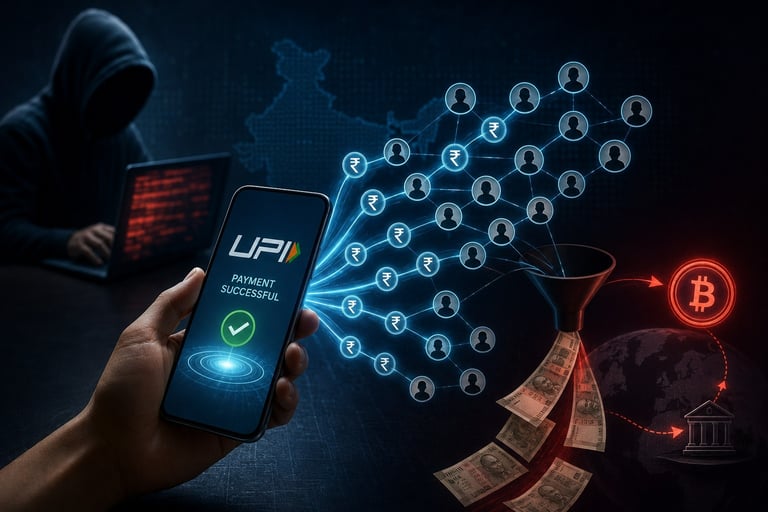
The mechanism is no longer a localized, amateur operation; it is an industrialized asset class known as "Mule Account as a Service." Here is how the modern laundry cycle works in the digital age:
The Bait: Syndicates recruit everyday citizens—students, gig workers, or holders of long-dormant accounts—often through social media, offering "easy commissions" to rent out their bank credentials.
The Velocity: Once a cyber scam (like investment or digital arrest fraud) hooks a victim, the stolen money hits these legitimate-looking mule accounts. It is instantly fragmented via UPI into dozens of rapid, smaller transactions to stay right under regulatory radar thresholds.
The Exit: Before a compliance team can even flag the account, the layered funds are aggregated and funneled into crypto P2P platforms or offshore accounts, leaving the paper trail entirely cold.
For years, financial institutions have treated this strictly as a "fraud department" issue. But when organized syndicates build dedicated infrastructure to layer, disguise, and integrate illicit cash at scale, it stops being simple fraud—it becomes systemic money laundering.
Traditional AML frameworks were built for an era of manual audits and T+1 settlement days. To protect the integrity of India’s digital payment ecosystem, compliance must match the tech. Moving forward, the fight requires real-time, behavioral AI capable of flagging a dormant account that suddenly spikes into a multi-layer UPI conduit, cutting off the network before the cash evaporates.
Speed is the pride of India’s fintech economy. We cannot let it become the launderer's greatest asset.